
Thermal
Energy Storage (TES)
Dispatchable industrial heat — stored when energy is
clean or low-cost, delivered when your operations demand it.
Advanced acid gas control
Protecting equipment and environment from harmful emissions
Industrial Heat — On Your Schedule
Flexible, dispatchable energy
without disrupting operations
Industrial energy demand rarely follows a perfect curve. Prices fluctuate, loads swing, and waste heat is often available at the wrong time. LJUNGSTRÖM Thermal Energy Storage (TES) captures energy when it is clean or low-cost and returns it to your process exactly when operations require it — as steam, hot air, or thermal oil.
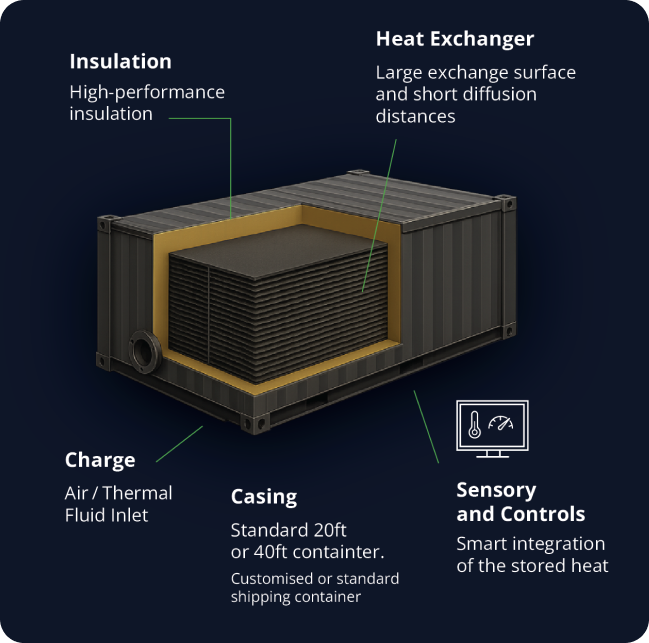
The modular, containerized system integrates in parallel with existing thermal assets, lowering fuel use and emissions while giving operators greater control, resilience, and flexibility in how energy is consumed.
Why Operators Choose LJUNGSTRÖM TES
Key Advantages Include:
Modular &
Scalable Design
Built in standard
20- or 40-ft containers
for flexible capacity expansion.
Rapid
Deployment
Short lead times enable fast, drop-in integration.
Multi-Media Compatibility
Operates with flue gas, air, steam, or thermal oil.
Wide Temperature Capability
Performance range tailored through material selection.
Integrated Heat Exchange Technology
Seamlessly incorporates LJUNGSTRÖM heat exchangers.
Minimal Site Disruption
Containerized design simplifies installation and limits downtime.
Peak Shaving & Waste Heat Recovery
Reduces operating costs by optimizing energy use.
Decarbonization & Green Finance Eligibility
Supports emissions goals and qualifies for green-funding programs.
At the core is a high-temperature solid storage matrix designed for durability, chemical resistance, and industrial longevity
Designed for
Retrofit Reality
TES connects in parallel with existing boilers and thermal loops. Operations continue. Risk stays low.
Built to:
- No major process redesign
- Parallel operation with legacy systems
- Installations measured in days or weeks depending on site
- Phased scale-up as demand or funding expands
Outcomes: This approach allows plants to decarbonize step by step while protecting uptime.
Charge From
What You Have
LJUNGSTRÖM TES is built to absorb energy from multiple sources:
Includes:
- renewable electricity
- surplus grid power during low-price periods
- industrial waste heat from exhaust, kilns, furnaces, or reactors
A Faster Route to
Decarbonization Funding
Because TES is modular, quick to deploy, and directly reduces fossil fuel consumption, projects align well with incentive structures across Europe and North America. Short implementation timelines also help organizations meet funding windows and CO₂-reduction milestones sooner.
of Heat Supply
Built for Energy-Intensive Industries
Chemicals & Petrochemicals
Pulp
and Paper
Food
and Beverage
Glass, Cement, and Building Materials
Metals and Downstream Heat Treatment
Automotive
Ovens and
Paint Shops
District
and Campus Energy
Systems
Let’s Evaluate Your Site
LJUNGSTRÖM engineers will assess integration points, charging sources, and storage profiles to define a scalable deployment roadmap.
Industrial heat, delivered when you need it.
Ready to explore what TES could look like at your facility?
Let’s start the conversation.